


Above inflation funding rates announced for 2026-27
The Government has published its new hourly funding rates for the funded early education and childcare entitlements for 2026-27. All three rates will increase at a higher rate than the National Living Wage rise. The Early Years Pupil Premium (EYPP) gets a significant increase too.
However, although this will cover the majority of staff, rises for younger staff members are a higher percentage rise than the uplift to the funding rates.
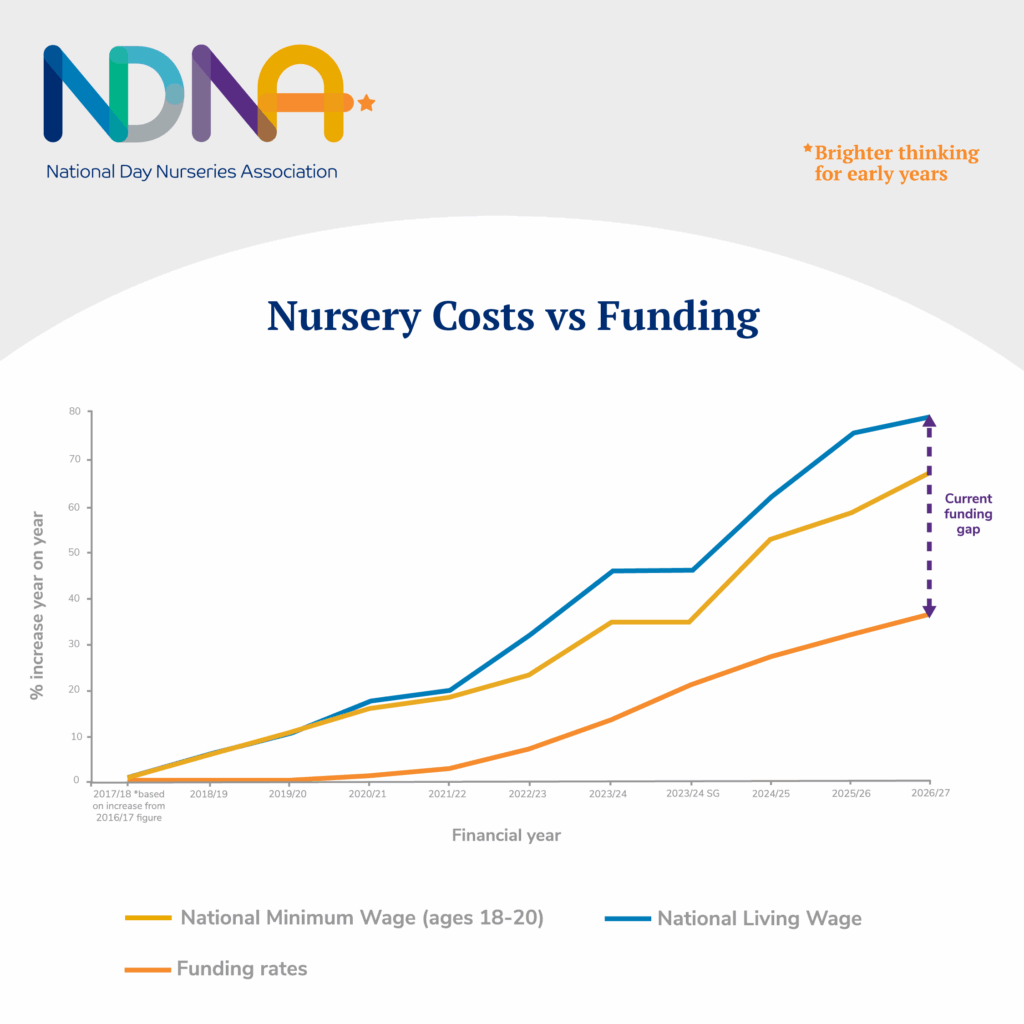
For three and four-year-olds though, the gap will narrow slightly as a result of next year’s rates, with an average 4.95% increase.
Since 2018 NDNA has been highlighting concerns about huge underspends in local authority budgets which last year amounted to £65 million. The DfE has announced they will carry out termly head counts for three and four-year-olds from April as they currently do for under threes. This will increase the number of returns providers have to make but should make funding decisions more accurate.
To offset any loss of funding from this new approach, local authorities will receive a termly funding adjustment to ensure rates can be raised in line with the 4.95% average increase.
Here’s the key figures:
Funding rates 2026-27:
- 3 and 4 year olds – up by 4.95%, with average rate being £6.42 and lowest being £6.01, with 50 local authority areas receiving the lowest funding rate
- Due to a change in headcount reporting, the DfE is adding a one-off additional amount (termly adjustment) of between 17 and 26p per hour (apart from Camden at 5p and Westminster at 0p) but local rates will still be close to the above
- 2 year olds – up by 4.36% with average rate of £8.90 and lowest rate around £7.66 for Rutland
- Under twos – up by 4.28% with average rate of £12.04 and lowest rate £10.34 for Rutland
- From April councils must pass through at least 97% of their allocation to providers, an increase of 1% from the current 96%.
See the minimum wage rises 2026-27: https://ndna.org.uk/nurseries-need-funding-to-pay-wage-increases/
Early Years Pupil Premium 2026-27:
- From April this will be increasing by 15% to £1.15 per hour per child or £655.50 per year
- This is in addition to last year’s 45% increase
- This brings it closer to the Pupil Premium for schoolchildren which is currently £1,515
- We don’t know what the increase will be for Pupil Premium yet
Universal Credit:
- Today’s announcement also states that the childcare element of Universal Credit will cover all children from families with more than two children
- However providers and families have reported to NDNA increasing numbers of issues where the cost of meals and snacks at nursery is not being covered by UC
Tim McLachlan, Chief Executive of NDNA, said:
“We are pleased that the Government has listened to the early years sector and will pay above inflation increases to hourly funding rates which should help providers to pay the statutory wage uplift for the majority of practitioners. With the mandatory pass-through rate set at 97% for next year, nurseries who are struggling with rising costs should notice the difference.
“Staffing costs make up the bulk of nurseries’ outgoings. However, the funding rate increase is below general wage inflation and a lower percentage lift than the younger minimum wage rises.
“NDNA has been pushing for rates for three and four-year-olds to reflect the reality of delivering these places and this uplift of around 5% will narrow the gap between costs and funding. There has been historic underfunding of this policy, which has led to the gap we see between provider income and operating costs.
“With the Government purchasing 80% of early years places, it’s vital they get the funding rates right so that nurseries can deliver these places, remain sustainable and invest in their staff to deliver high quality provision for our children.
“We also welcome the additional money to bolster the Early Years Pupil Premium to support disadvantaged children, something NDNA has been campaigning for over many years. Investing more in a child’s earliest years gives them the best life chances and saves money in their later education.
“NDNA will continue to support providers locally, holding local authorities to account for budget underspends in early years and ensuring they share their funding arrangements with providers locally as soon as possible to support planning for next year.
“Getting rid of the two-child limit for Universal Credit is another positive step. But the Government needs to make sure the childcare element includes the cost of meals for funded children if families are to feel the full impact of this decision.”
Local authorities have until 28 February to share their local plans for base rates and other supplements which could include deprivation supplements and SEND inclusion funds.
Secretary of State for Education Bridget Phillipson said:
“High-quality childcare is the first building block of national renewal, and central to how we get tens of thousands more children school ready by age five. It shapes children’s futures, it strengthens working families, and it supports communities across our country.
“That’s why we are delivering a record £9.5 billion investment in early years, with nurseries and childminders receiving higher hourly funding rates. This is more money going straight to the frontline, helping providers grow, improve and offer every child the best possible start.
“This is how we build a brighter future for our country – by investing in children, backing families and restoring opportunity from day one.”
See NDNA’s spreadsheets to see your local rates and how they compare with the rest of your region and other regions:
Please note, we have used the DSG rates provided by DfE before the termly funding adjustment has been made because we believe this will more closely represent the rates received by providers.
- England
- Department for Education
- early education
- early education funding
- early years
- England
- funding
- Funding Rates
- local authorities
- National Minimum Wage
- NDNA
Similar Articles
Childcare Offer for Wales funding rate rising by 4%

Ministerial letter: changes to EYFS safer sleeping requirements