

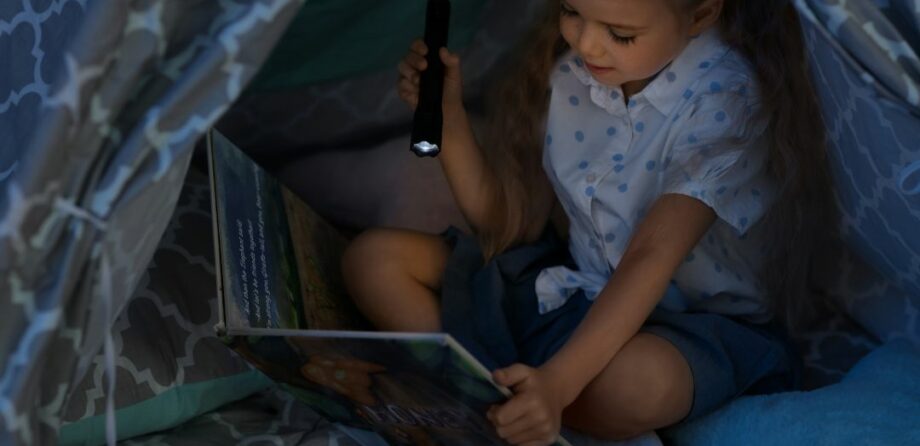
Early years activity: Poetry in the Dark
It’s that time of year when the dark nights are closing in and children are noticing the changes in the world around them. This activity provides an opportunity for children to explore darkness in an exciting way by using all their senses in a familiar environment, giving them the confidence and skills to share ideas and create a group poem.
Poetry in the dark learning aims
- Use their senses to explore
- Use descriptive language to communicate what they think and feel
- Listen, discuss and share ideas with others
- Work collaboratively
- Use words purposefully.
Resources you will need for this activity
Poem about the dark, such as ‘River sky’ by Joseph Coelho Dark tent/blankets/cosy dark area Torches Objects to make shadows A3 paper and pens.
Poetry in the dark activity outline
- Read the poem and draw attention to words which describe darkness. Point out any features such as the moon, stars and shadows
- Discuss darkness and talk about how darkness makes them feel and what they notice when it is dark. Ask questions like, “What can you see when it is dark?” Introduce and explain any new vocabulary
- Create a dark space and invite the children to explore. Encourage them to use their senses and notice what is different when the lights are off
- Encourage children to share their observations with questions such as, “What can you see?”, “What do you think that shadow might be?” and “Can you describe what it is like?”
- Switch on the torches and encourage children to investigate the shapes, shadows and patterns they can see. Ask, “What shapes can you see?”, “Let’s think of the words together.” Introduce new vocabulary such as ‘silhouette’ and explain what it means
- Explore how dark makes them feel by switching off the torches. Discuss using vocabulary like calm, curious, scared, excited or sleepy. Talk about how darkness is also an important part of the natural world and how and some animals like owls and hedgehogs come out at night to explore
- Create a group poem together. Recap the words the children have used to describe the dark. Invite the children to take ownership of the poem by working together to choose words and phrases to include. Support them to decide how these words can be put together, for example “The dark is quiet and…”
- Bring the poem to life by reciting it aloud using actions, expressions and tone of voice to show meaning of the words; talk about how the voice and actions can help the listener imagine the dark
- Model whispering for words like ‘dark’ and ‘spooky’, pretend to sleep for words like ‘night’ or gently flap arms for an ‘owl’. Ask children to contribute, e.g. “What action can we choose for ‘twinkly stars?’
- Once they have chosen the actions, perform the whole poem together.
Ideas to extend this activity
- Bring the poem to life by reciting it aloud using actions, expressions and tone of voice to show meaning of the words; talk about how the voice and actions can help the listener imagine the dark
- Model whispering for words like ‘dark’ and ‘spooky’, pretend to sleep for words like ‘night’ or gently flap arms for an ‘owl’. Ask children to contribute, e.g. “What action can we choose for ‘twinkly stars?’
- Once they have chosen the actions, perform the whole poem together.
NDNA products to help you with this activity
Vocabulary and Early Language Skills – online course – Included in your membership
Disclaimer: Activities with children must always be risk assessed, including for allergies or choking. Children must always have adequate supervision. Resources and materials must always be appropriate for children’s age and stage of development.
- Activity
- MyNDNA
Similar Articles
Top tips: Digital safety and safe use of technology

Top tips: Effective progress tracking
