


Booming Demand, Shrinking Sector. The Real Story Behind Nursery Closures.
Written by: TradeBridge · Early Years Finance
Demand for childcare has never been stronger. So why are nurseries still closing? The problem isn’t demand. It’s finance that doesn’t match how nurseries actually get paid.
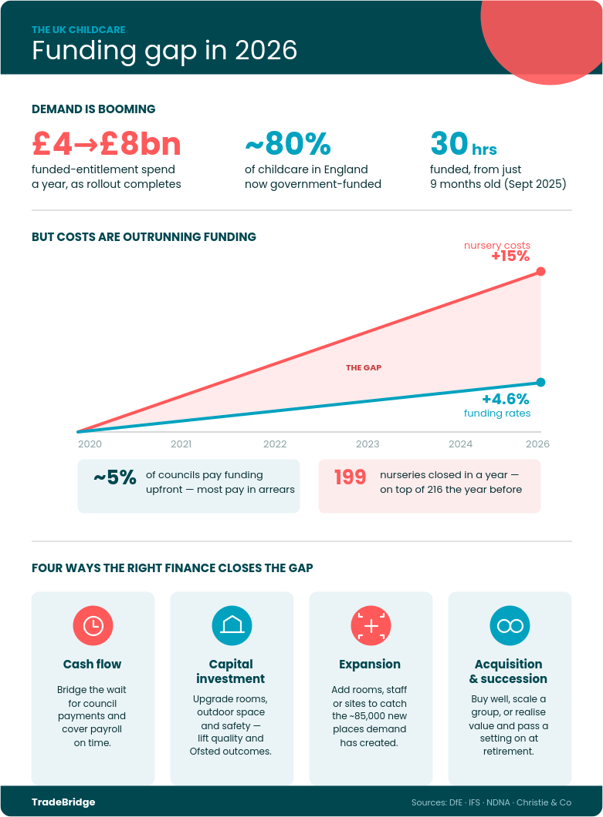
You already know the numbers because you’re living them. Government spending on the early years entitlement has nearly doubled in two years, to £8.7bn1, and funded hours now make up around 80% of many settings’ income2. On paper, that should mean nurseries are thriving.
Instead, NDNA‘s research found 199 nurseries closed in the year to September 2024, on top of 216 the year before, affecting more than 10,000 children2. Staffing costs rose around 15% while funding rates rose 4.6%2. And that funding often lands weeks after you’ve already paid the wages it’s meant to cover3.
This isn’t a demand problem. It’s a cash flow and growth-capital problem, and it’s solvable. Four pressure points come up repeatedly in conversations with childcare providers.
Cash flow: bridging the wait for council payments
You deliver care every day. But you get paid on the council’s timetable, and NDNA’s investigation found only around 5% of councils pay funding upfront3. Most pay in arrears, and many not until week three or four of the month3. With staff wages eating up 70–80% of your costs4, that gap can land squarely on payroll. The right finance, a revolving facility secured against your funded-hours receivables, turns that income into cash when you need it, not weeks later.
Capital investment: keeping settings modern and compliant
Buildings, outdoor space, sleep rooms, safeguarding and energy efficiency all need investment, and funding rates rarely stretch far enough to cover it. Capital finance built for the sector lets you upgrade without draining your operating account, protecting both quality and your Ofsted outcomes as well as attracting more parents.
Expansion: capturing the new demand
The entitlement expansion means more demand than ever, especially for under-twos. The National Audit Office estimated 85,000 additional places were needed by September 2025 alone2. New rooms, staff and sometimes new sites all cost money before the extra funded hours start coming in. Growth finance sized against your future funded income means you can expand ahead of demand, not scrambling to catch up.
Acquisition & succession: consolidating a fragmented market
The sector is still overwhelmingly independent, and it’s consolidating fast: large groups (21+ settings) accounted for 61% of completed deals in Christie & Co’s latest market review6, and three in four operators said they’re looking to buy, sell, or both this year5. If you’re ambitious to grow, finance for acquisition helps you buy well. If you’re planning your exit, the same tools help you realise value and hand your setting on cleanly.
Finance built around how nurseries actually work
That’s the thinking behind TradeBridge early years finance.
Over the last year we supported dozens of nurseries with millions of pounds in funding limits. Rather than treating nurseries like any other small business and lending only against property, we size funding against what you’re already owed:
- Sized against funded-hours receivables, not just property
- Fast and flexible, matched to your termly and monthly payment cycles
- Revolving for day-to-day cash flow, with capital and acquisition options as you grow
“The fundamentals for success in the UK childcare are strong: demand is structural and the payer is the government. The missing piece has been finance designed for how nurseries actually operate. Which is where TradeBridge comes in”.
Find out how flexible funding could help your nursery run better and grow faster.
Talk to TradeBridge about early years funding.
SOURCES
1. Free entitlement spending £4.4bn→£8.7bn, IFS Annual Report on Education Spending 2025–26: https://ifs.org.uk/publications/annual-report-education-spending-england-2025-26
2. 199/216 closures, staffing +15%/funding +4.6%, 80% of income from government hours, 85,000 additional places needed (NAO estimate): NDNA: https://ndna.org.uk/nurseries-continue-to-close-as-government-funded-childcare-expands/
3. 5% of councils pay upfront, late payment timing: NDNA investigation via Nursery World: https://www.nurseryworld.co.uk/content/news/councils-creating-funding-cashflow-problems-for-early-years-settings-as-hundreds-close-their-doors
4. Staff wages 70–80% of nursery costs: Adam Smith Institute: https://www.adamsmith.org/blog/childcare-costs
5. 75% of operators planning to buy/sell in 2026: Christie & Co Business Outlook 2026: https://www.christie.com/news-resources/press-releases/business-outlook-2026-children-day-nurseries/
6. 61% of completed deals to large groups: Christie & Co Day Nurseries Market Review 2026: https://www.christie.com/news-resources/press-releases/day-nurseries-market-review-2026/
- Business
Similar Articles
Top tips: Inclusive Physical Storytelling

Early years activity: Outdoor Storytime
