

Schools with nurseries more than twice as likely to be given “needs attention” grading: Government should refocus childcare policy
An investigation by National Day Nurseries Association (NDNA) has revealed that Ofsted gradings show that far more schools with early years provision are receiving “needs attention” grades.
The investigation is published on the day of NDNA’s national conference in Liverpool where nursery owners and managers from across the UK will network and be inspired by speakers from early education, including Minister Olivia Bailey and Sir Martyn Oliver, HMCI of Ofsted.
NDNA’s investigation also highlights that Ofsted’s new Report Cards are still giving parents varying information about schools with nurseries compared to standalone private or voluntary settings.
This means parents are unable to make like for like comparisons and make informed decisions about where to send their child.
An analysis of the new Ofsted reports from private, voluntary and independent (PVI) nurseries showed that 100% of their report related to that nursery. But for schools with nurseries, only a third of the report on average related in any way to their early years provision.
If parents are to use the new inspection grading system to inform their choices about where to send their child, they have much less information about school nurseries. They are also not able to compare the two because inspectors scrutinise PVI nurseries in much more detail.
These findings strengthen NDNA’s call for the Government to replace the current two-tier nursery inspection system with a single, consistent approach that treats all children and providers fairly.
NDNA is also urging ministers to pause the expansion of school-based nurseries and review the benefit of investment towards existing early years settings. The research provides further evidence that standalone PVI settings often deliver higher-quality early years provision, echoing the findings under the previous Ofsted inspection framework.
NDNA’s CEO Tim McLachlan said:
“We have seen that schools with nurseries are far more likely to ‘need attention’ or even require ‘urgent attention’. This should cause the Department for Education to stop and pause its plans to roll-out more provision in these schools.
“Investment should go into what works: the existing private, voluntary and independent nursery provision which continues to deliver high-quality provision to millions of our youngest children.
“If the Government continues with the current unfair Report Card approach, then there are improvements that need to be made to the Ofsted inspection regime. We need greater clarity about the early years expertise of inspectors who go into the wider school inspection.
“Our initial analysis at the start of the year suggested that schools were more likely to get an ‘exceptional’ grade but this has become more even in the more recent inspections.
“Parents can see every aspect of what happens for their children reflected in the more detailed standalone inspections that private, voluntary and independent nurseries receive. This clearly gets diluted when the report card in a school-based setting covers everything across the whole school, with early years a tag-on.
“This can mean that as little as a quarter of a report card can be directly relevant to a nursery that is based in a school. We want to see equality and fairness in inspections and reporting for standalone settings and school-based nurseries. It is a fairer representation for nurseries, fairer for parents and most importantly fair for every child.
“Ministers need to direct Ofsted to inspect and report on nurseries in the same way – the same inspection framework, same reports and same early years inspectors, not two different systems. Only then will parents be able to truly compare settings and have confidence in a system that is fair for every child, whatever setting they attend.
“They must also review whether their focus on school-based nurseries is the best direction for children’s outcomes when they are more likely to be letting our youngest children down.”
NDNA’s analysis of report card gradings:
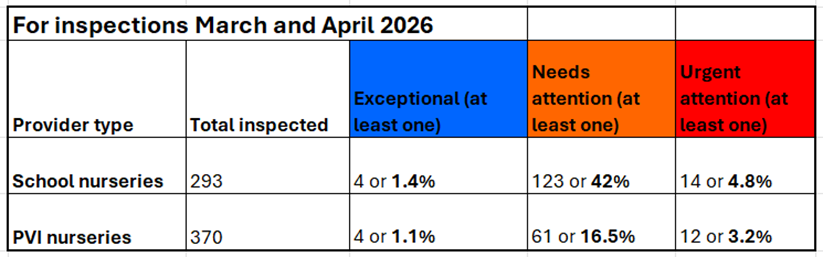
NDNA’s own analysis of PVI nursery reports published since January 2026 has borne out the claims that very few are given the top grade of “exceptional” for any aspect of their provision, compared with nurseries in schools.
The gap is closing. In January, four nurseries in schools received exceptional grades compared with no PVI nurseries. This shifted in March and April: four of both types of nursery received at least one “exceptional” area, equating to 1.4% of school nurseries and 1.1% of PVI nurseries.
PVI nurseries are more likely to have a mix of strong and expected grades, whereas schools tend to have a range of judgements. As a result, 42% of schools with nursery provision have at least one “needs attention” grading compared with 16.5% of PVI nurseries. More school nurseries were given the lowest grade: “urgent attention” – 4.8% compared with 3.2% of PVI nurseries. More than a third of schools with a “needs attention” judgement received it for their early years provision.
How inspections differ
NDNA asked Ofsted for more detail on the number of inspectors looking at schools with nurseries – and whether they are specialists in early years education. Ofsted confirmed that they are currently “analysing this information in relation to inspections and we intend to publish this in 2027”.
Analysis of information given in different reports
NDNA’s investigation team then looked at five sample reports published this year for PVI nurseries and for schools with nursery provision from across the country in a range of types of deprivation. We looked at four areas to see how much of the report wording related to early years provision:
• Leadership and governance
• Curriculum
• Achievement
• Inclusion
For PVI nursery inspections, the entire report related to their nursery, so 100% was relevant to early years education.
For schools with nurseries, it varied from 26% to 46% of the overall wording, but on average was around 34%. This included references to staff and oversight, training etc.
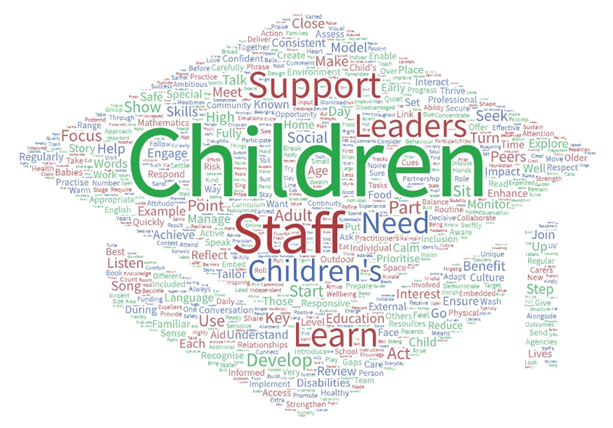
Word clouds showed that there was a different focus between school reports and PVI nursery reports. For PVI nurseries, the key words were children, followed by staff, support, leaders, learn, children’s needs:
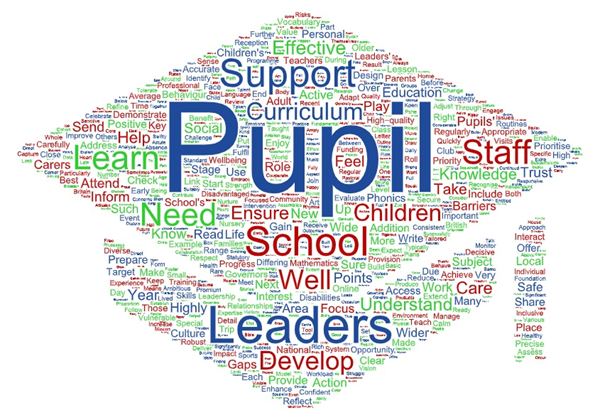
For school reports, it shifted to: Pupil, leaders, school, staff, support, develop, curriculum:
- England
- childcare
- Department for Education
- DfE
- early education
- early years
- England
- government funding
- NDNA
- nurseries
- Ofsted
Similar Articles
Improving children’s outcomes is the top priority in Wales-Scotland agreement

Calls growing to raise the earnings threshold for funded childcare
