
Early years activity: Fruit Salad
Encouraging healthy eating habits from an early age is essential for children’s growth and development. Making a fruit salad provides opportunities for children to explore different tastes, textures, weights and colours while developing positive attitudes towards nutritious foods.
Fruit salad learning aims
- To introduce children to a variety of fruits and healthy food choices
- To develop fine motor skills through preparing fruit
- To encourage language development by describing tastes, colours, weights and textures
- To support understanding of hygiene and safe food practices.
Resources you will need for this activity
- A selection of soft fruits (e.g. bananas, strawberries, blueberries, melon)
- Natural fruit juices (e.g. apple, orange, cranberry) (optional)
- Child-safe knives
- Chopping boards
- Small bowls.
Fruit salad activity outline
- Introduce the activity in advance by talking to the children about your plans to make fruit salads. You could create a shopping list based on the children’s choices and, if possible, visit a local shop together to buy the fruit
- Once you have the fruits, share them with the children and talk about their colours, shapes, weights, names, etc. This is a great opportunity to encourage discussion and curiosity
- Explain to the children that the fruit needs to be prepared for eating and some need washing or peeling. Encourage the children to guess what the fruit will look like inside
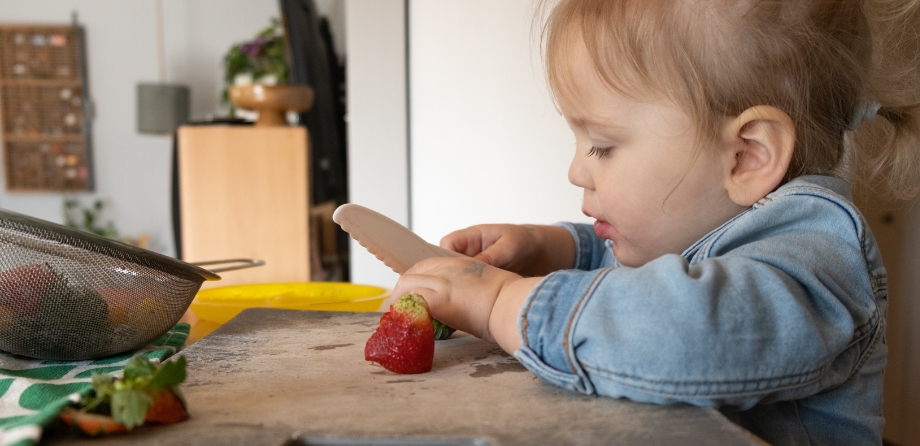
- Provide the children with cutting boards and child safe knifes and demonstrate how to safely prepare the fruits. Where appropriate, support children to cut soft fruits. If this is not possible, prepare the fruit in front of the children so they can observe the process
- Allow time for exploring the prepared fruit by encouraging children to touch, smell and taste it. Support language development by modelling descriptive words and ask open-ended questions like, “Which fruit has the scrummiest smell?” You could talk about how it looks different now to how it did before it was prepared
- Once all the fruit is prepared, invite the children to add their chosen pieces into their own bowls to create individual fruit salads to enjoy. You could add a little natural fruit juice such as apple or cranberry juice
- Reinforce positive messages about healthy eating throughout the activity by modelling enthusiasm and using age-appropriate language. For example, talk about how fruit helps our bodies grow strong, gives us energy to play and keeps us healthy
- Praise children for trying new foods and making healthy choices
- Involve the children in tidying up the area to promote a sense of responsibility and independence.
How to extend this activity
Create a ‘fruit chart’ where children can vote for their favourite fruit. Display pictures of the fruits used in the activity and invite each child to vote for their favourite by placing a sticker or a mark next to the fruit they enjoyed the most. As a group, count the votes together, encouraging early maths skills such as counting, comparing quantities and identifying more and less. Talk about the results by asking the group to identify which was the most popular and least popular etc.
NDNA products to support you with this activity
- Developing high quality practice nursery training – Face to Face training
- The developing child: super skills for learning – Online Course
Disclaimer: Activities with children must always be risk assessed, including for allergies or choking. Children must always have adequate supervision. Resources and materials must always be appropriate for children’s age and stage of development.
- Activity
- MyNDNA
Similar Articles
Top tips: Inclusive Physical Storytelling

Early years activity: Outdoor Storytime
