

Early years activity: Loose parts art-faces
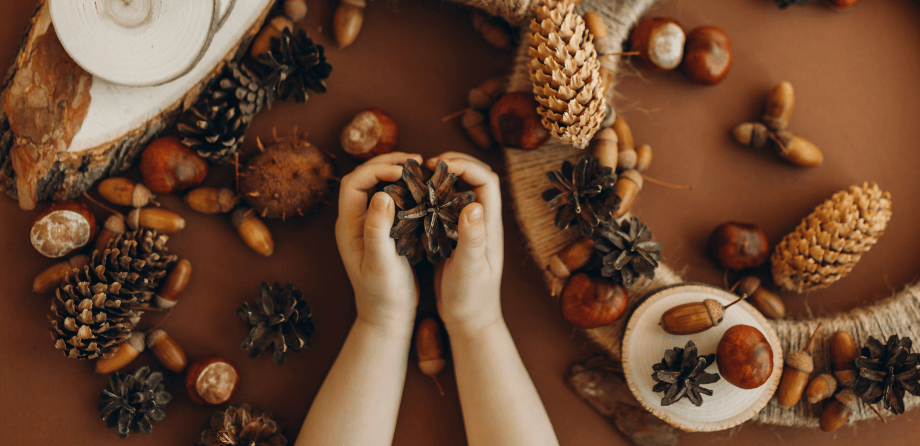
This loose parts art activity encourages children to create faces using a variety of open-ended materials. They are then able to describe their faces and perhaps their emotions that they have included in their art.
Loose parts art-faces learning aims
- Explore and create using a variety of loose parts
- Develop fine motor skills
- Use imagination to represent faces
- Talk about their ideas and choices.
Resources you will need for this activity
Provide a wide range of loose parts, including but not limited to:
- Mirrors
- Wooden slices
- Pebbles and small stones
- Shells
- Pinecones
- Leaves and sticks
- Bottle tops
- Buttons
- Fabric scraps
- Feathers
- Corks
- Circular boards/ paper as a base for the facial features (optional).
Loose parts art-faces activity outline
- Begin by talking with the children about different faces and emotions (happy, sad, surprised, silly). Provide mirrors so children can look at their own faces and notice features such as eyes, noses and mouths
- Introduce the loose parts and model a simple example without over-directing. Encourage children to generate their own ideas, e.g. “What can we use for eyes?”, “What would make a funny mouth?”
- Support learning through open-ended questioning such as, “Tell me about your creation”, extending vocabulary and promoting communication
- Observe and scaffold where needed, supporting fine motor development and turn-taking while allowing children to lead their own creative process
- Ensure all materials are safe and appropriately sized, supervise closely at all times
- The children could take photos of their creation and dictate or scribe a comment about their face, to make a display in the setting. Use your knowledge of children’s rhyme selections to identify their favourite number rhymes
- Prepare props to go along the rhymes you will be singing, for example, create 5 currant buns and some pennies. Invite children to hand over a penny as they buy a bun, physically removing one bun at a time as you count down
- Many number rhymes count backwards, for example, ‘5 Little Ducks’, so ensure you include number rhymes that count forwards, such as, ‘1,2,3,4,5 Once I Caught a Fish Alive’, or 1, 2 Buckle my Shoe’
- Send parents the words to the number rhymes you use so they can sing them at home with their child
- Keep the rhymes playful and fun – change the song words to match children’s interests or personal experiences, e.g. 5 Little Ducks becomes ‘5 Large Dinosaurs’ or ‘5 Currant Buns in a Baker’s Shop’ becomes ‘5 Juicy Melons from the Market Stall’
- Encourage children to choose their favourite rhymes to sing and to change the words to create their own version of the rhymes.
How to extend this activity
Children can be further challenged to create a family of faces, while adults observe their language use, independence and control of small movements.
NDNA products to support you with this activity
Your essential guide to Loose Parts Play Ideas – Practice guide
Disclaimer: Activities with children must always be risk assessed, including for allergies or choking. Children must always have adequate supervision. Resources and materials must always be appropriate for children’s age and stage of development.
- Activity
- MyNDNA

