
Majority of Scottish councils not paying genuinely ‘sustainable rates’
An investigation by National Day Nurseries Association (NDNA) Scotland has revealed that the majority of councils in Scotland are failing to adequately cover the increase in costs for partner providers in their funding rate for the 2026-27 period.
This leaves providers and parents to pick up the slack and pay for the difference themselves. Nurseries in two local authority areas are yet to find out what their new funding rates will be, almost five months after they were due to apply.
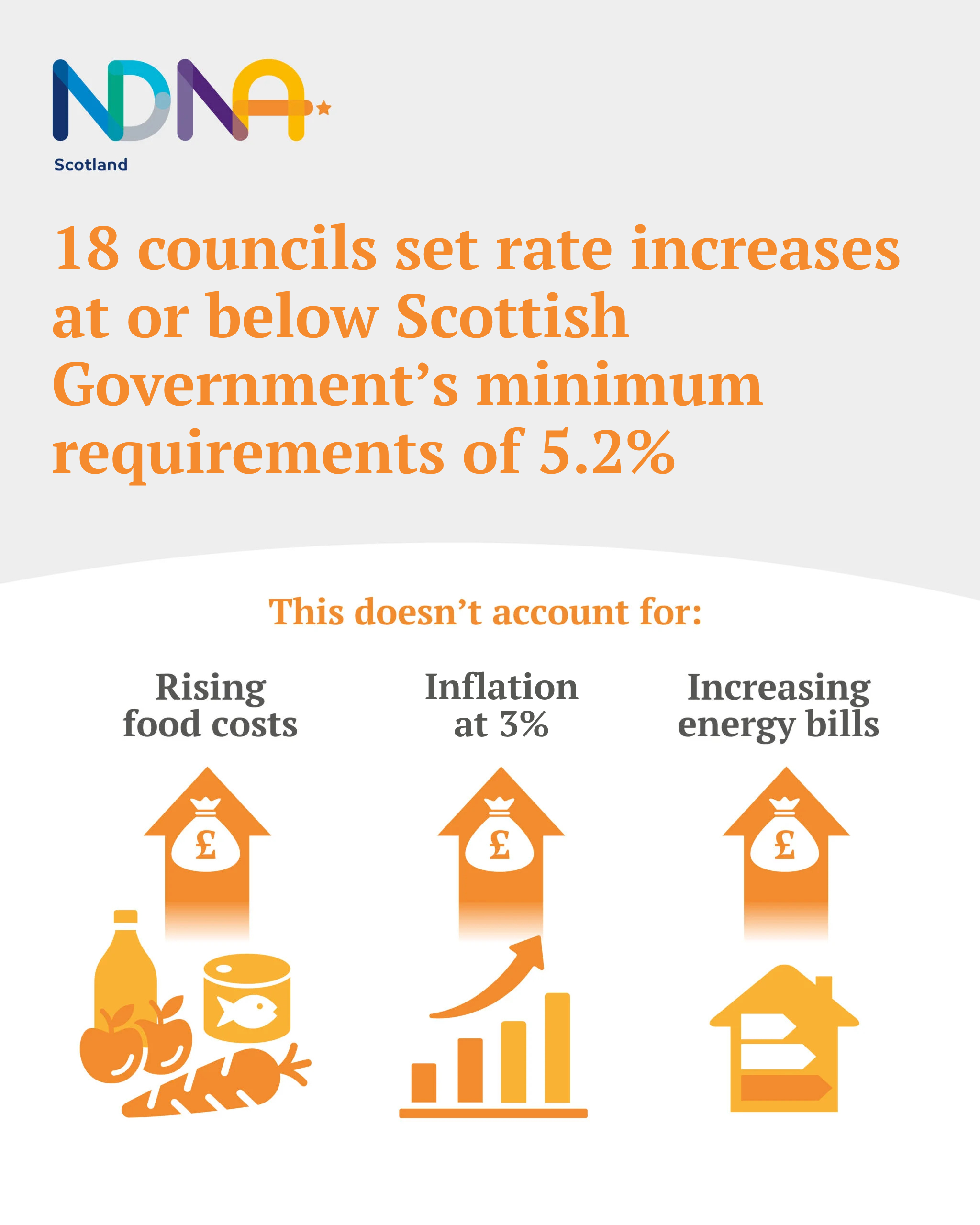
The Scottish Government has set a minimum requirement of a 5.2% increase in hourly rates to pay providers for funded early learning and childcare (ELC) places. This is the minimum required to cover the increase in the Real Living Wage, but this figure does not account for any other cost increases for partner providers such as rising food prices and energy bills.
Tim McLachlan, Chief Executive of NDNA, said: “Everyone in early learning and childcare across Scotland wants to see children and families thrive through the funded hours. However, we are seeing councils taking very different approaches to supporting partner providers like nurseries, who are critical in the delivery of the Government’s policy.
“It’s disgraceful that the majority of nurseries are not having the full impact of rising costs taken into account when councils set their hourly funding rates. The Scottish Government is clear that the 5.2% uplift is the absolute minimum allowed – and some councils aren’t even reaching that in the figures they have shared with us.
“In many areas rate increases have not kept pace with the true rise in the cost of running an ELC setting. There has been chronic underfunding for years so every year that increases do not keep pace with rising costs makes it harder and harder for providers.
“These are not ‘sustainable rates’. We want to see the Scottish Government undertake a serious review of the rate setting process to ensure this cannot happen again. This is more important than ever as Ministers consider how to roll-out expanded childcare offers for families.
“For providers in areas where councils are yet to set rates, they will have children starting places this month but they do not know how much funding they will receive for these places. This is a ludicrous situation resulting in significant cash flow challenges, with some having to rely on reserves to make ends meet.
“A more efficient and effective alternative would be to give all parents an online account for all of their childcare support, which they could use to pay their choice of provider. This would remove the current postcode lottery for providers and families.”
NDNA Scotland’s findings in more detail:
Two councils (7% of responses received) did not even meet the minimum requirement set out by the Scottish Government. Midlothian and the Scottish Borders Councils are failing to pass on the full amount of funding provided to them by the Scottish Government to partner providers.
A further 16 councils, more than half, have increased rates by the minimum 5.2%, leaving partner providers and parents to cover the cost of 3% CPIH inflation since the rates were last set (ONS, 2026).
NDNA estimates that when taking into account both staffing and general inflation, costs will have increased on average by 5.9% between April 2025 and April 2026*. Only seven councils exceeded that funding target for the 2026-27 offer, with an additional council exceeding the figure for eligible twos funding but not for three to five-year-olds.
Renfrewshire and East Dunbartonshire responded to the request to say they have not yet set a rate for their partner providers. This is leaving nurseries facing cash-flow issues because they have had a legal duty to pay the new Real Living Wage since April without any respective increase in funding.
Partner providers in East Dunbartonshire are having to wait until October to find out their new sustainable rate. This means providers will have spent six months having to cover increased costs without even being able to plan around how much of that cost they will be receiving in back-dated funding.
A nursery provider in East Dunbartonshire told NDNA Scotland:
“It has been incredibly frustrating on many levels. We had expected to know the increase before summer, but at a meeting in June, we heard that it was not going to committee until October, as other more important things had come up. We have not had a cost of living increase for three years, the uplift over the last few years has purely been to cover government tax NI and minimum wage increases.
“As a business it means we are unable to plan financially for the future. We are taking a guess at how much we might need to increase our fees by, which also means then that parents are taking the hit financially. By not receiving any increase until October we are having to dip into reserves to cover increases, which impacts where we spend money on resources, improvements etc.
“I don’t know another sector or business that goes into a contract with a local authority and the LA decides how much they will pay for the service, not how much it costs the contractor to deliver the service.”
Another nursery based in East Dunbartonshire cited cashflow issues and difficulties planning ahead as a result of the delayed decision.
She said: “Providers are carrying significant costs while waiting for decisions that should already have been agreed. As small businesses, we don’t have that money sitting in the bank.
“This money should be in place in April, not backdated months later. The uncertainty makes it incredibly difficult to plan, invest and operate sustainably.”
Scottish Borders gave the lowest increase which has left nurseries there struggling with staffing costs which have not been reflected in their 5% uplift.
One owner told NDNA Scotland: “It’s got to the point where it’s not financially sustainable. The staffing bill is crippling. I literally lost a whole room team within 12 weeks.
“We’re expected to deliver high-quality childcare, but funding simply isn’t keeping pace with costs. Families are being forced to make decisions based on affordability rather than continuity of care.
“If you want partnership working to succeed, you need to listen to providers and act on what they’re telling you. Local authorities should be partners, not competitors.”
FOI request and statistics
NDNA Scotland conducted a collection exercise from councils in July and August using requests under Freedom of Information (FOI) legislation. The exercise asked for their new sustainable rates for 2026/27 to fund places for eligible two-year-olds and three to five-year-olds as well as the percentage uplift of each compared with the previous year’s rate.
Summary of the investigation findings
| Eligible 2s | 3-5s | |
| Average rate increase | 6.1% | 5.66% |
| Average funding rate | £7.67 | £7.20 |
| Highest increase | Inverclyde 17.4% | Stirling 9.3% |
| Lowest increase | Scottish Borders 5% | Scottish borders 5% |
| Highest rate | Shetland Islands £9.98 | Fife, Scottish Borders £8.09 |
| Lowest rate | Stirling £6.15 | Stirling £5.80 |
| No rate set | Renfrewshire, East Dunbartonshire | Renfrewshire, East Dunbartonshire |
| No response received | Perth & Kinross, Moray | Perth & Kinross, Moray |
| Number below minimum requirement | 2 | 2 |
| Number at minimum requirement | 16 | 16 |
| Number exceeding minimum requirement | 10 | 10 |
| Number exceeding minimum requirement and inflation | 8 | 7 |
*77% of costs were staffing costs which had a 6.7% increase and the remaining 23% of costs had a 3% increase meaning an overall increase of 5.9%
https://www.ons.gov.uk/economy/inflationandpriceindices/bulletins/consumerpriceinflation/april2026
Scottish Government guidance for setting sustainable rates Funded early learning and childcare 2026-27: guidance for setting sustainable rates
Similar Articles
More to do to get Ofsted inspections right despite positive signs
Conservative Party Proposes to Remove Earnings Limit on Funded Childcare Places