EYFS profile results: Children making good progress particularly in maths and literacy
The Department for Education (DfE) has released the Early Years Foundation Stage (EYFS) profile results for 2025/26 which show positive improvements in most areas.
These annual statistics report on teacher assessments of children’s development at the end of the EYFS, typically the summer term of the academic year in which a child turns 5. The assessment framework consists of 17 early learning goals (ELGs) across 7 areas of learning.
The government has set a target for 75% of children to reach a good level of development in the EYFS profile assessment by 2028. Early Years Minister Paul Waugh has written to the nursery sector to thank you for your work to support children’s development.
Key statistics:
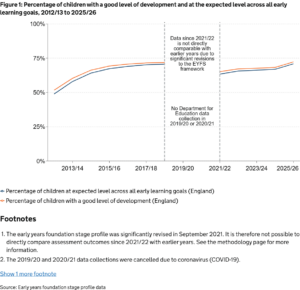
- 72.3% of children achieved a Good Level of Development (GLD), up from 68.3% in 2024/25
- 70.9% reached the expected standard across all 17 ELGs, up from 66.9% a year earlier
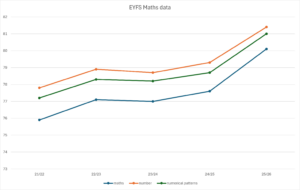
- Since the introduction of the revised EYFS framework in 2021/22 the percentage of children at the expected level in maths has risen from 75.9% to 80.1%
- The number and numerical patterns ELGs have also risen from 77.9% to 81.4% and 77.2% to 81% respectively
- The only area to have improved more than maths during that time is literacy, having improved from 68% in 21/22 to 74.3% in the latest figures.
Attainment gaps have narrowed in many areas:
- More girls are still reaching GLD than boys at 78.6% and 66.3% but that difference has narrowed
- The difference between the 10% most and the 10% least deprived areas in 2025/26 was 19.1 percentage points, narrowing from 20.2 percentage points in 2024/25 and 21.2 percentage points in 2021/22
- But fewer children with EAL, children eligible for free school meals and summer-born children got a GLD compared to peers.
Tim McLachlan, Chief Executive of National Day Nurseries Association (NDNA) said: “Today’s results show the amazing work which is happening across our sector every day. We know that children’s developmental progress in the early years shapes their learning throughout the rest of their education and therefore their life chances. With private, voluntary and independent settings delivering the vast majority of early education and care places we can be proud of what our sector is achieving for children up and down the country.
“We are delighted with the progress that is being made in the area of maths which has seen some of the biggest improvements in recent years. Our Maths Champions programme funded by the DfE was rolled out nationally in 2023 and has grown from 400 Champions to reaching 5,000 in the current wave. The research shows that this approach improves children’s maths and literacy progress by three months compared with their peers and this impact is even greater for children from disadvantaged backgrounds. With the number of Maths Champions growing every day, this area of learning can go from strength to strength as more educators in nursery boost their confidence in teaching early maths.
“While there is a lot to celebrate in today’s results we need to remain focussed on what more can be done. We are closer to the Government’s target of 75% of children to reach a good level of development by 2028 but achieving this means we cannot lose focus or investment at a critical time. This requires the Government, as the largest purchaser of early education places, ensuring the rates they pay providers keeps pace with rapidly rising costs, and being clear with parents that this is part funding not ‘free’ or full funding. It also means maintaining focus on key areas like maths but also addressing the attainment gap for children from more deprived backgrounds.
“The Milburn review noted that children who fall behind by age five are almost three times as likely to be NEET at 17. Investing early now can give children better chances for the future and the Chancellor needs to find ways to support the sector in his upcoming Budget, addressing underfunding and removing unfair burdens like Business Rates from essential nurseries.”
Minister Waugh wrote in his letter to the sector: “As Minister for Early Education, I appreciate the fundamental importance of the work you do as an Early Years leader to support every child in your setting. Early childhood development is strongly associated with later outcomes, providing the foundation for achievements throughout school and beyond. Children who reach a good level of development (GLD) at age five are more likely to succeed at school and less likely to be not in education, employment or training (NEET) later in life. I want to put on record the Government’s recognition of, and respect for, the vital role that you play in ensuring children have the support they need to thrive.
“This is a shared mission, with success depending on schools, early years, and local leaders understanding the needs of the children and families in their local communities and using data to identify gaps and target proven approaches where they are needed most.
“You play an incredibly important role in ensuring that children in your care get the best start in life.”
Find out more about our fully-funded Maths Champions programme which is making such a difference to children’s outcomes here.
- Department for Education
- early years
- eyfs
- Maths Champions
Similar Articles
More to do to get Ofsted inspections right despite positive signs
Conservative Party Proposes to Remove Earnings Limit on Funded Childcare Places