


Inspection of funded nursery education in Wales
Who are Estyn?
Estyn are the education and training inspectorate for Wales responsible for reviewing the quality and standard of education. Estyn is led by His Majesty’s Chief Inspector of Education and Training in Wales. Estyn are independent of the Welsh Parliament but funded by the Welsh Government. The word Estyn is Welsh for ‘to reach out’ or ‘to stretch’ and their vision is to improve the quality of education and training and outcomes for all learners in Wales.
As well as inspecting, Estyn also provide advice and guidance to the Welsh Government on quality and standards. They are also extremely keen to share interesting and innovative practice they have witnessed during an inspection and will invite providers to write case studies on said practice to share on their website.
Why do Estyn inspect?
Legislation sets out the powers of His Majesty’s Chief Inspector of Education and Training in Wales. This includes what the Chief Inspector may or must inspect and report on, how often providers must be inspected and details for publishing inspection reports. Estyn inspect quality and standards in a range of schools, settings and educational establishments including non-maintained settings that receive funding from local authorities to deliver nursery education. The main primary legislation governing the inspection of non-maintained nursery settings is the Education Act 2005. A setting registered with a local authority to deliver nursery education (Early Education / Entitlement) to three and four-year-olds will be inspected by Estyn.
Joint inspections
Since January 2019, Estyn have been working alongside Care Inspectorate Wales (CIW) to complete joint inspections of non-maintained nursery settings, in order to support the streamlining of the way CIW and Estyn inspect children’s education and care services. Following a comprehensive review, an updated version of the joint inspection framework for the non-maintained sector is to be used from September 2026.
Read the joint inspection framework here: How we inspect funded non-maintained nursery and childcare settings.
Prior to inspection
Notice – You will receive ten working days’ notice of an inspection. An inspection co-ordinator will contact you to make arrangements for the inspection and query any general health and safety precautions.
Sharing required information – A secure digital system called the Virtual Inspection Room (VIR) is used for settings to upload information before the inspection, access inspection guidance and complete post-inspection questionnaires (PIQs). Annex A of the ‘How we inspect funded non-maintained nursery and childcare settings’ provides a list of documents required to be uploaded to the VIR before the inspection by the setting and Annex B lists the documents that should be available during the inspection.
Self-assessment and evaluation – Pre-inspection self-assessment information can be in any format, although Estyn and CIW promote using one large document over multiple smaller documents, whilst ensuring all children are covered within it as well as the care and education standards. Although the document itself is required, inspections will focus in on the ‘processes’ of self-evaluation and not just the document itself. The inspectors are looking for strategic evaluation, something that is thought about, planned for and routinely reviewed. Self-assessment should be authentic and not just a ‘box-ticking’ exercise.
Informing parents/carers and children – Parents/carers must be informed about the inspection and ‘questionnaires’ or ‘surveys’ must be completed to gain their views. It is also good practice to inform the children of the visit to mitigate any increased anxieties of having unknown adults enter the setting on the day. In the days leading up to the inspection, revisit the notion that these people will be visiting the setting and assure the children that they are able to approach and talk with them and that they may be approached themselves and asked some questions. To support practitioners in exploring the inspection process with children, prior to the visit, Estyn and CIW have produced a storybook – Our Nursery. A pdf version of the book can be viewed and downloaded on the Estyn website. Our Nursery storybook.
The inspection framework
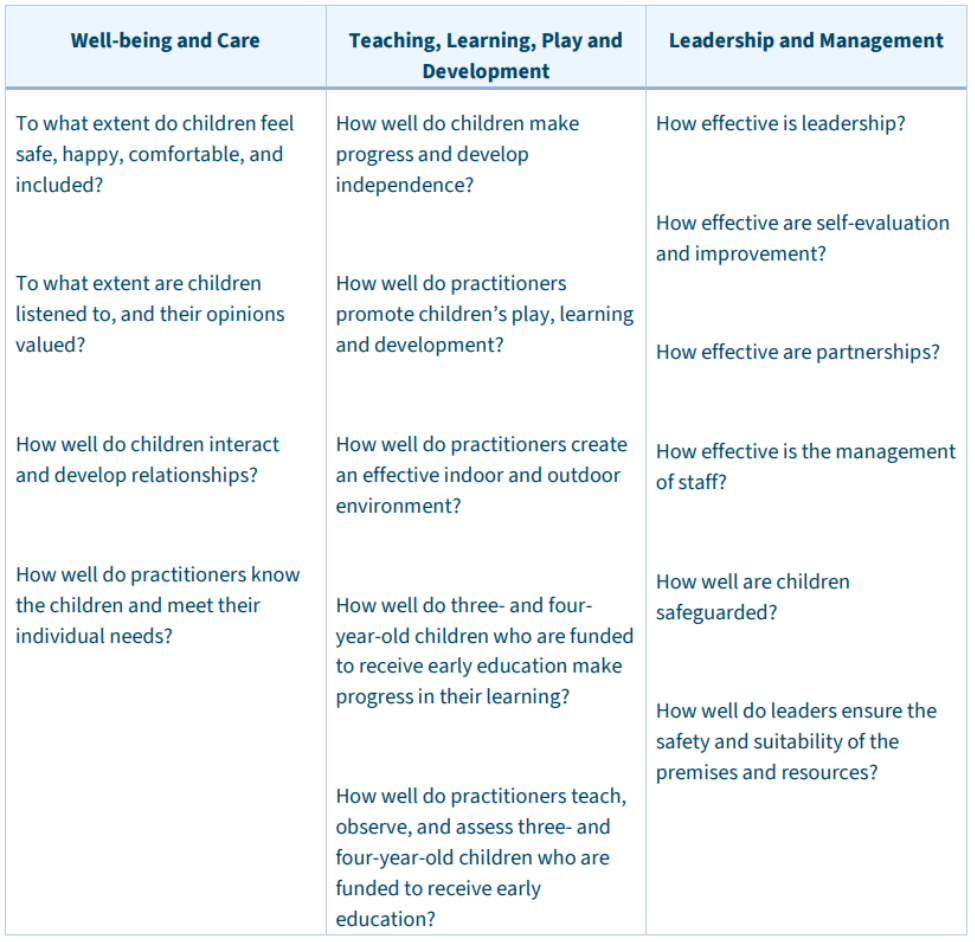
The updated joint inspection framework contains three themes:
1. Well-being and Care
This considers how well practitioners support children’s well-being, provide care, and how children respond.
2. Teaching, Learning, Play and Development
This considers how practitioners support children’s learning and development, and the impact on outcomes.
3. Leadership and Management
This considers the effectiveness of leadership and management within the setting.
Inspectors make one overall judgement for each theme, covering the setting’s provision as a whole.
The inspection itself
Inspection visit – The joint inspection visits will normally take place over two consecutive half-days. DO NOT change your usual routines for the inspection. This will upset the dynamics of your setting and the routines of the children, something that the inspectors will notice. You do not need to cancel visits, visitors or family / community activities. The inspectors want to see your setting as it presents itself every other day of the year. If these activities have been planned with careful consideration for the children’s care and education, then leave them in and inform the inspector prior to their visit.
Inspectors – The inspectors work as a team and move around the whole setting. Where settings offer care for children up to the age of 12, an additional CIW inspector may inspect the out of school provision as part of this joint inspection. Information from this visit will inform the overall joint inspection findings. The inspectors will collate information from both of their visits to feed into the joint inspection report. Please note that you are not required to provide a place for the inspectors to work in but if the space allows, this may be something you wish to consider and this is where you also may want to hold the post-inspection feedback meeting.
For more detailed information on what to expect during an inspection visit, refer to pages 10-11 of the inspection guidance: ‘How we inspect funded non-maintained nursery and childcare settings’
After the inspection
Feedback – At the end of the inspection formal feedback will be provided. The feedback meeting provides the opportunity for leaders and managers to hear and to reflect on the inspection team’s findings and judgements. You are able to invite a CWLWM representative (E.g. a NDNA Cymru staff member) to the feedback meeting as well as your Local Authority Early Years Advisory Teacher if you wish to do so.
Ratings and recommendations – Inspectors will include a separate rating for each of the themes inspected (excellent, good, adequate or poor) and recommendations for improvement. The recommendations should give the setting a clear and specific indication of the areas identified for improvement that it will need to address. The ratings shared during a feedback meeting are provisional and subject to moderation and validation. They are also confidential and should not be shared with anyone outside of the feedback meeting, including via social media, until CIW and Estyn publish the report on their websites. Where there may be a breach of regulation or noted areas for improvement during a joint inspection, CIW will follow their Securing Improvement and Enforcement Policy.
Effective practice – The inspection team will also consider if there is any effective practice in the setting. This may be highlighted through a ‘spotlight on’ the practice within the report from Estyn or a practice worth sharing web page from CIW.
Reports – Reports will be produced within 45 working days from the start of the inspection. Before publication, settings will receive a draft inspection report to check for factual accuracy. The setting will normally have five working days to identify any factual errors. This is not an opportunity to challenge the inspection findings, but to correct inaccuracies in the report only.
Concerns and complaints – If a setting has concerns about the inspection process or the conduct of an inspector, these should be raised with the lead inspector as soon as possible during the inspection. Each inspectorate has its own complaints procedure, available on its website.
Estyn complaints handling procedure
Follow-up activity – The inspection team will consider whether the setting needs any follow-up activity and will inform the setting within the feedback meeting. This is based on the judgements and any non-compliance identified for each theme. A setting will normally require follow-up if inspectors find important weaknesses, which impact on outcomes for children or pose a potential risk to their safety or well-being. This would usually result in a ‘poor’ rating.
Further information on can be found within: Follow-up Joint CIW/Estyn inspections Non-maintained settings, September 2021.
NDNA Cymru member support
If you feel you would like additional support with an upcoming inspection, or an inspection that has just taken place, as an NDNA Cymru member, you can access face-to-face, email, phone call or video call support for you or your staff.
Contact a member of the team:
Early Years Education Officer, Hayley Grayson - [email protected]
Regional Development Manager, Sarah Warburton – [email protected]
CIW: https://careinspectorate.wales/
Estyn: https://www.estyn.gov.wales/
- Wales
- Cymru

